


Project Blue Book:
A Comprehensive Analysis of the Blue Book UFO Documents
Introduction and Historical Context
Project Blue Book was the United States Air Force’s longest-running official investigation into unidentified flying objects (UFOs), operating from 1952 to 1969 as a direct response to widespread public concern about aerial phenomena and Cold War national security anxieties. The project was headquartered at Wright-Patterson Air Force Base near Dayton, Ohio, and represented the third major investigative initiative following Project Sign (1947–1949) and Project Grudge (1949–1952).af+3
The investigation emerged from a post-World War II surge in UFO reports, beginning with Kenneth Arnold’s seminal June 24, 1947 sighting near Mount Rainier, Washington, when he observed what he described as nine crescent-shaped objects traveling at approximately 1,700 miles per hour—far exceeding any known aircraft capability at the time. Arnold’s account generated significant media attention and popularized the term “flying saucer,” catalyzing the formation of Project Sign in December 1947 as a classified Air Force initiative to investigate potential threats to national security.wikipedia+2
Organizational Structure and Methodology
Investigation Framework
Project Blue Book operated under two fundamental objectives: determining whether UFOs posed a threat to national security and conducting scientific analysis of UFO phenomena using systematic investigative procedures. The project represented an evolution toward more rigorous methodology compared to its predecessors, employing standardized questionnaires, data collection protocols, and IBM computer analysis to process the vast volume of reports.esd.whs+4
The investigative process followed three phases: receipt and initial investigation of UFO reports at the nearest Air Force base; detailed analysis and categorization at Project Blue Book headquarters; and dissemination of conclusions to relevant government agencies. Reports were classified into three categories: Identified, Insufficient Data, and Unidentified. This taxonomy allowed investigators to distinguish between cases with definitive explanations and those requiring further study or lacking adequate information for determination.unwritten-record.blogs.archives+3
Scientific Direction and Personnel
Dr. J. Allen Hynek, an astronomer from Northwestern University and Ohio State University, served as the project’s principal scientific consultant throughout its operational lifespan. Initially skeptical of UFO claims, Hynek later became a prominent advocate for rigorous scientific investigation, eventually developing his influential classification system for close encounter cases. His shift from skepticism to cautious inquiry reflected his frustration with what he perceived as inadequate investigative procedures, leading him to note in a 1968 correspondence with Air Force officials that Project Blue Book suffered from “numerous procedural problems and a lack of resources, which rendered its efforts ‘totally inadequate.'”enigmalabs+3
Captain Edward J. Ruppelt served as the project’s first and most influential director during its formative years (1952–1953). Ruppelt, who originated the term “Unidentified Flying Object” (UFO), established rigorous investigative standards and emphasized collaboration with multiple government agencies, observatories, and research institutions. His systematic approach provided Project Blue Book with its most productive and scientifically grounded phase.sofrep+3
Explained Cases: Classification and Frequency
Overall Statistical Breakdown
Of the 12,618 total sightings reported to Project Blue Book between 1947 and 1969, 11,917 cases (94.4 percent) received explanations for their origins, while 701 cases (5.6 percent) remained categorized as “unidentified.” The explained cases represented a diverse array of natural phenomena, human-made objects, and misidentifications.archives+4
Categories of Explained Cases
Astronomical and Meteorological Phenomena (approximately 25 percent): These included well-known celestial bodies and atmospheric effects. Bright stars such as Venus, Jupiter, Mars, and Capella accounted for numerous reports, particularly when viewed through atmospheric haze, fog, or unusual light conditions that produced optical distortions. Venus alone generated substantial reporting activity, particularly during twilight hours when its brilliance could exceed that of celestial bodies and create illusions of movement or anomalous behavior. Meteors and meteorites, including fireballs and bolides, represented another significant subcategory, though the vast majority of such observations fell within established astronomical parameters.wikipedia+4
Aircraft and Aircraft-Related Phenomena (approximately 20 percent): Conventional military and civilian aircraft accounted for a substantial portion of explained sightings. Modern jet aircraft, when observed at high altitudes and at distance, produced reflection effects from their metallic surfaces that could generate disc or rocket-shaped silhouettes. Vapor and condensation trails from jet engines, when illuminated during twilight hours, frequently appeared to glow fiery red or orange, producing dramatic visual effects that generated UFO reports. Notably, the U-2 spy aircraft, with its operational ceiling exceeding 70,000 feet, accounted for more than half of all UFO reports during the late 1950s and throughout the 1960s. U-2 flights were classified at the time, and their high-altitude silvery surfaces, when catching sunlight reflected at unusual angles to lower-flying airliners, created photographic effects indistinguishable to observers from extraterrestrial craft.history.navy+3
Balloons and Airborne Research Devices (approximately 16 percent): Weather balloons, radiosondes, and large research balloons—some reaching diameters of 300 feet—generated numerous reports, particularly when illuminated at dawn or dusk. The sun’s reflection on balloon surfaces at these times created distinctive visual phenomena. High-altitude wind streams could propel such balloons at speeds exceeding 100 miles per hour, contributing to reports of extraordinary velocity. Critically, Project MOGUL, a then-classified surveillance balloon project designed to detect Soviet nuclear weapons tests, accounted for the famous Roswell incident of 1947. The Air Force’s initial 1947 public statement about recovering a “flying disc” was followed by a retraction attributing the debris to a weather balloon, though declassified records from 1995 revealed the debris actually originated from Project MOGUL, whose true nature remained classified until the Cold War’s end.blogs.library.unt+3
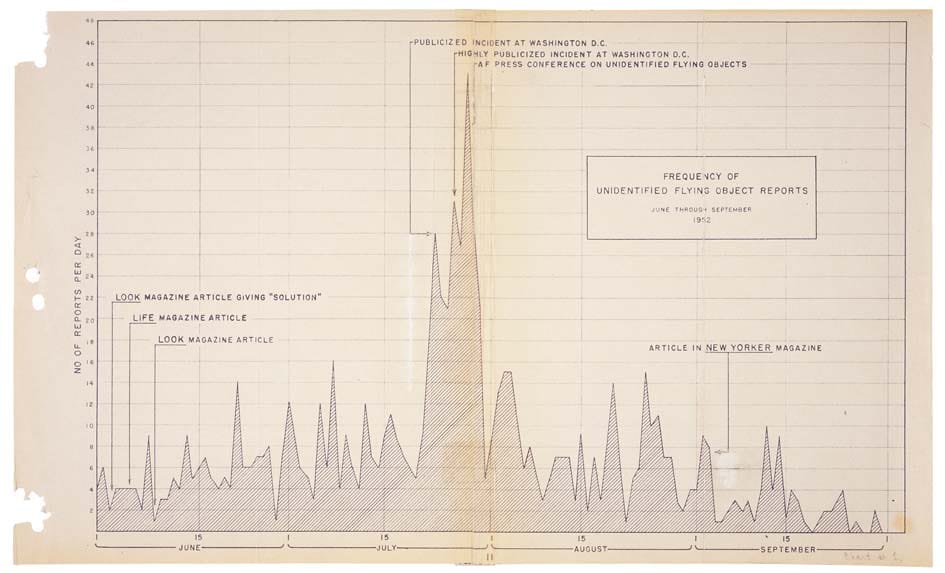
Atmospheric Effects and Optical Phenomena: Project Blue Book classified numerous sightings as resulting from stellar mirages, light refraction through temperature inversions, ball lightning, and other transient atmospheric phenomena. The 1952 Washington, D.C. UFO incident, involving multiple radar targets and visual sightings that generated significant public alarm and media coverage, was eventually attributed to false radar images caused by temperature inversions—though radar operators and military personnel present disputed this explanation.wikipedia+3
Satellites, Missiles, and Military Ordnance (approximately 13 percent as “Other”): The increase in space vehicle launches during the 1950s and 1960s generated UFO reports of satellites, missile tests, and classified military systems.defense+1
Artificial Phenomena and Human Activity: Searchlights, fireworks, flares, aircraft afterburners, and other deliberately generated light phenomena accounted for additional cases.prologue.blogs.archives+1
Psychological and Fraudulent Reports: Project Blue Book explicitly acknowledged that human psychology—including misperception, suggestibility, psychological disturbance, fabrication, and deliberate hoaxes—contributed to a measurable portion of sightings. By the end of its investigation, only approximately 6 percent of total cases remained unexplained, suggesting that 94 percent of cases possessed explanations, whether astronomical, atmospheric, technological, psychological, or fraudulent in nature.britannica+2
Unexplained Cases: The 701 Remaining Unknowns
Nature of Unexplained Cases
Despite rigorous investigation, 701 cases (5.6 percent of total sightings) remained classified as “unidentified” even after comprehensive analysis. These cases, however, did not constitute acceptance of extraterrestrial origin hypotheses. Rather, the “unidentified” classification indicated that investigators possessed insufficient data, conflicting evidence, or observational characteristics that did not match known phenomena with certainty—though terrestrial explanations remained the presumption.nsa+5
The Air Force’s official conclusion explicitly stated that there existed “no evidence submitted to or discovered by the Air Force that sightings categorized as ‘unidentified’ represent technological developments or principles beyond the range of present-day scientific knowledge” and “no evidence indicating that sightings categorized as ‘unidentified’ are extraterrestrial vehicles.”af+2
Significant Unexplained Cases
The Socorro Landing (April 24, 1964): One of the most meticulously documented cases involved Socorro, New Mexico Police Sergeant Lonnie Zamora, whose reputation for integrity was confirmed by Project Blue Book investigators. Zamora reported observing an egg-shaped craft approximately 150 yards away, standing on four legs, with two figures in white coveralls nearby. The object bore an unusual insignia resembling an arrow pointing upward from a horizontal base to a half-circle crown. Witnesses reported landing marks, burned vegetation, and shallow holes consistent with landing gear impressions. The case remained unsolved, though skeptics proposed alternative explanations including a hoax by New Mexico Tech students, a mirage of the star Canopus, or a lunar landing device test by White Sands Missile Range personnel. However, the investigator’s notes designated this case as “the best-documented case on record.”cia+2
Levelland, Texas UFO Case (November 2–3, 1957): Described by ufologists as one of the most credible UFO incidents in American history, the Levelland case involved approximately 15 documented reports from multiple reliable witnesses, including police officers and the local sheriff, over a concentrated geographic area and time period. Witnesses reported vehicle engine failures concurrent with UFO observations, unusual electromagnetic effects, and luminous objects displaying non-ballistic characteristics. Project Blue Book investigator concluded the sightings resulted from ball lightning during an electrical storm, though ufologists James E. McDonald and J. Allen Hynek disputed this explanation, noting that no electrical storm occurred during the sighting window and that ball lightning cannot produce automobile engine failure. Additionally, the official investigator interviewed only 9 of the 15 documented witnesses, raising methodological concerns.wikipedia+2
The 1952 Washington, D.C. UFO Flap (July 19–27, 1952): This incident represented one of Project Blue Book’s most controversial cases and generated unprecedented media attention. Multiple radar centers at Washington National Airport and Andrews Air Force Base tracked unidentified targets simultaneously on two weekend dates (July 19–20 and July 26–27), with radar operators calculating speeds up to 7,000 mph—far exceeding contemporary aircraft capabilities. Civilian airline pilots, USAF officers, and radar specialists observed correlated visual phenomena. F-94 Starfire jet interceptors were scrambled, with pilots Lieutenant William Patterson reporting that objects were “all around me” at his aircraft’s maximum speed, stating he “ceased chasing them because I saw no chance of overtaking them.” Navy radar specialist Lt. John Holcomb concluded the radar targets were “good and solid returns” from metallic objects, dismissing temperature inversion explanations as inadequate. Project Blue Book ultimately attributed the case to temperature inversions and misidentified celestial objects, yet both Edward Ruppelt (Project Blue Book director) and investigator Michael Wertheimer documented that radar personnel disputed the official explanation. Former radar controller Howard Cocklin stated in 2002: “I saw it on the [radar] screen and out the window.”popularmechanics+1
The Minot Air Force Base Incident (October 24, 1968): This case involved multiple corroborating observers including Strategic Air Command B-52 crew members, radar operators at multiple facilities, and ground-based security personnel at a nuclear ICBM complex near Minot, North Dakota. Radar personnel tracked an anomalous target maintaining three-mile distance from the B-52, then closing to one-mile range at high speed while the aircraft attempted descent. Both B-52 UHF radios failed during the encounter. Missile launch facility intruder alarms were activated without apparent cause. The encounter lasted over three hours with coordinated ground and airborne observations. Project Blue Book’s final report tentatively suggested “ionized air plasma similar to ball lightning” as explanation, acknowledging that “plasmas of this type will paint on radar and also affect some electronic equipment at certain frequencies,” yet concluded “plasmas are not uncommon, however, they are unique and extremely difficult” to explain in this context.minotb52ufo+2
The Mariana UFO Incident (August 15, 1950): Nick Mariana, general manager of the Great Falls Electrics minor league baseball team, filmed 16 seconds of motion picture footage of two bright silvery rotating objects moving at estimated speeds of 200–400 mph near Great Falls, Montana. The film was analyzed by the Navy Photo Interpretation Laboratory, which expended approximately 1,000 man-hours of professional analysis, concluding the objects were “self-luminous,” “not birds, balloons or aircraft,” and exhibited “no blinking while passing through 60 degrees of arc” because they lacked the reflective characteristics of known objects. The Robertson Panel, reviewing the case in 1953, could not accept the laboratory’s conclusions despite acknowledging the impressive analytical effort. Notably, portions of Mariana’s original film disappeared after Air Force examination, particularly the section allegedly showing the objects hovering over the Great Falls Refinery with greater clarity, raising evidentiary concerns.wikipedia+2youtube
The Rendlesham Forest Incident (December 26–28, 1980): Though technically beyond Project Blue Book’s 1969 termination, this incident at RAF Woodbridge and RAF Bentwaters in Suffolk, England—referred to as “Britain’s Roswell”—involved credible U.S. Air Force personnel, including Deputy Base Commander Lt. Col. Charles Halt, who documented a triangular metallic craft with colored lights, landing gear, and anomalous electromagnetic effects. The incident generated the famous “Halt Memo” to the UK Ministry of Defence and has remained controversial despite official skepticism.allthatsinteresting+1
Scientific Methodology and Investigative Evolution
Early Rigor and Systematic Approach (1952–1955)
Project Blue Book’s initial phase, under Ruppelt’s direction, emphasized systematic data collection and scientific analysis. Approximately 60 percent of reported UFOs were readily identifiable as balloons, aircraft, or astronomical phenomena through cross-referencing with flight records from the Civil Aeronautics Administration, military air bases, weather service balloon telemetry, astronomical almanacs, and observatory data. This screening process allowed investigators to concentrate analytical resources on genuinely ambiguous cases.sacred-texts
The project employed what was effectively an early computerized data management system, utilizing IBM punch-card technology to process and analyze 2,500 military reports plus approximately 1,000 civilian questionnaire responses from 1947–1952. Project BEAR (Battelle Memorial Institute), contracted to conduct statistical analysis, applied rigorous mathematical methodology to identify distinguishing characteristics between identified and unidentified cases.upload.wikimedia+1
Robertson Panel and Institutional Redirection (1953)
The Robertson Panel, established in January 1953 in response to the 1952 Washington, D.C. sightings, fundamentally altered Project Blue Book’s investigative mandate. The panel, chaired by physicist Howard P. Robertson and composed of prominent scientists, concluded unanimously that UFOs posed no direct threat to national security but could pose an “indirect threat” by overwhelming military communications with false reports during potential Soviet attacks, creating opportunities for exploitation of public hysteria.wikipedia+2
Critically, the Robertson Panel recommended that Project Blue Book shift from genuine scientific investigation to a public debunking campaign. The panel specifically advised “stripping the Unidentified Flying Objects of the special status they have been given and the aura of mystery they have unfortunately acquired” through planned public relations initiatives. This recommendation fundamentally transformed the project’s character, redirecting resources from investigation toward explaining away sightings, regardless of evidentiary merit.science.howstuffworks+4
A declassified memorandum from CIA official Karl Weber, writing in 1966, acknowledged the consequences: efforts to suppress public disclosure of CIA involvement in UFO investigations “only drew more attention” to the Robertson panel report, establishing a pattern of institutional opacity that would characterize the project through its conclusion.sgp.fas
The Condon Committee and Project Blue Book’s Decline (1966–1969)
By the mid-1960s, Project Blue Book had become increasingly focused on debunking rather than investigation. In response to sustained public and congressional pressure, the Air Force commissioned the University of Colorado UFO Project, directed by physicist Edward U. Condon, to conduct an allegedly independent scientific review.wikipedia+2
The Condon Committee examined hundreds of Project Blue Book cases and other UFO reports through 1968. Its 1,485-page final report, released in January 1969 as the Scientific Study of Unidentified Flying Objects (commonly termed the Condon Report), reviewed 59 detailed case studies. Condon’s introduction stated: “Our general conclusion is that nothing has come from the study of UFOs in the past 21 years that has added to scientific knowledge. Careful consideration of the record as it is available to us leads us to conclude that further extensive study of UFOs probably cannot be justified in the expectation that science will be advanced thereby.”colorado+2
However, critics noted that the Condon Report itself identified approximately one-third of examined cases as unexplained, and subsequent analysis by Philip Klass and other commentators revealed that even many of the “explained” cases contained unconvincing explanations. Internal memoranda leaked to Look magazine in 1968 revealed that Condon and associates had predetermined negative conclusions before beginning substantive investigation—establishing a predetermined outcome rather than evidence-based inquiry.science.howstuffworks+1
Critical Debates and Methodological Controversies
The Hynek-Menzel Debate
Dr. J. Allen Hynek and Dr. Donald H. Menzel, Harvard astronomer and prominent UFO skeptic, engaged in a sustained intellectual debate regarding UFO investigation methodology. Menzel proposed explanations involving optical mirages from temperature inversions and stellar refraction, which he claimed could account for most UFO sightings. However, when Menzel submitted his theories for evaluation to Project Blue Book, neither Hynek nor other scientific consultants—including Dr. Joseph Kaplan of UCLA and Project BEAR researchers—accepted his explanations. When offered access to complete Project Blue Book records to apply his theories to unexplained cases, Menzel declined.saturdaynightuforia+1
Conversely, Hynek evolved from initial skepticism toward cautious acknowledgment that genuine anomalies existed. In a 1985 interview with Omni magazine, Hynek acknowledged: “I was a thorough skeptic, and I’m afraid I helped to engender the idea that it must be nonsense, therefore it is nonsense,” reflecting his recognition that premature dismissal represented poor scientific methodology.newsweek
James E. McDonald’s Advocacy
Dr. James E. McDonald, an internationally respected atmospheric physicist at the University of Arizona and expert in cloud physics and micrometeorology, emerged in the 1960s as an outspoken advocate for rigorous UFO investigation. McDonald publicly proclaimed UFOs to be “the greatest scientific problem of our times” and conducted extensive interviews with hundreds of witnesses. His prominence as an established scientist lent credibility to claims that Project Blue Book’s investigations were inadequate.bostonreview+1
Institutional Constraints and Procedural Limitations
By the late 1960s, Project Blue Book operated under significant constraints. Hynek’s correspondence with Air Force officials noted the project’s “totally inadequate” resources and procedures, particularly the insufficient depth of field investigations and inadequate time allocation for complex cases. Critics noted that Project Blue Book, despite investigating over 12,000 cases, achieved recognition primarily for debunking rather than rigorous analysis—a characterization supported by the shift in investigative emphasis following the Robertson Panel recommendation.wikipedia
The Condon Report: A Final Scientific Assessment
Composition and Methodology
The Condon Committee comprised 37 scientists writing chapters or portions of chapters for the comprehensive report. The investigation examined cases in five categories: old reports from before 1966, new reports, photographic cases, radar/visual cases, and UFOs reported by astronauts.wikipedia+1
Key Findings
The Condon Report concluded that—consistent with Project Blue Book’s determinations—UFO investigations had not contributed significantly to scientific knowledge and that further extensive study was unlikely to yield major scientific discoveries. Nonetheless, the report acknowledged significant limitations in existing scientific knowledge regarding “atmospheric optics, including radio wave propagation, and atmospheric electricity,” areas where UFO phenomena might contribute insights if investigated rigorously.colorado+2
Contested Interpretation
The report’s selective publicity obscured its more nuanced findings. While Condon’s introduction recommended against further UFO research, detailed case analyses documented that approximately one-third of investigated cases remained essentially unexplained, albeit often accompanied by speculative terrestrial explanations lacking compelling evidentiary support.popularmechanics+1
Institutional Context: Cold War National Security Concerns
Project Blue Book’s investigative priorities reflected Cold War anxieties regarding Soviet technological superiority. Initial Project Sign investigations considered the possibility that UFO reports represented Soviet advanced aircraft development, consistent with intelligence community concerns about Soviet technological capabilities. The investigation of “green fireballs” over nuclear weapons facilities at Los Alamos and Sandia National Laboratories during 1948–1949 exemplified the security-focused investigative framework.origins.osu+4
The CIA’s involvement in UFO investigations, through Project BEAR statistical analysis, the Robertson Panel, and internal agency reviews, reflected broader governmental concerns that UFO reports could mask detection of Soviet incursions into U.S. airspace or potentially facilitate exploitation of public panic during military emergencies. A declassified 1969 memorandum from Brigadier General C. H. Bolender, Air Force Deputy Director of Development, noted that “reports of UFOs which could affect national security should continue to be handled through the standard Air Force procedure designed for this purpose,” suggesting ongoing classified investigation outside Project Blue Book’s purview.cia+3
Declassification, Archives, and Contemporary Access
Since Project Blue Book’s termination on December 17, 1969, investigation ceasing in January 1970, all documentation has been declassified and transferred to the National Archives. As of 2015, Project Blue Book records became digitally accessible through online archives, enabling independent scholarly review. Current research initiatives, including collaboration between the Archival Research Catalog and GPT-4 vision systems, continue digitizing and optically character-recognizing case files to enhance public access to this significant historical documentation.reddit+3
Conclusions: The Persistence of Unexplained Phenomena
Project Blue Book represents a systematic, if ultimately constrained, attempt by the United States government to apply scientific methodology to unexplained aerial phenomena. The project investigated 12,618 cases spanning 1947–1969, identifying conventional explanations for approximately 94 percent of reports while leaving 701 cases (5.6 percent) unexplained.archives+3
While Project Blue Book’s official conclusions denied evidence of national security threats, technological principles beyond contemporary scientific knowledge, or extraterrestrial origin, these conclusions represented institutional positions rather than comprehensive scientific judgments. The Robertson Panel’s 1953 recommendation to prioritize debunking over investigation, coupled with institutional pressures to minimize public concern about unexplained phenomena, shaped investigative priorities in ways that subsequent critics have identified as constraining rigorous scientific inquiry.wikipedia+5
The 701 unexplained cases, though numerically representing a small percentage of total sightings, included incident categories characterized by multiple credible witnesses (often military or law enforcement personnel with specialized training), corroborating physical evidence, radar confirmation, and electromagnetic effects that collective analysis did not consistently accommodate within established scientific frameworks at the time of investigation.books.apple+6
Contemporary reassessment of Project Blue Book by academic institutions and government agencies, including the establishment of the Pentagon’s Unidentified Aerial Phenomena Task Force in 2020, suggests that institutional perspectives on these phenomena have evolved beyond Project Blue Book’s definitively dismissive conclusions. The project’s archival records continue serving as primary historical documentation for systematic study of unexplained aerial phenomena, enabling ongoing scholarly analysis that extends beyond the original investigative mandate.sofrep+1
- https://www.af.mil/About-Us/Fact-Sheets/Display/Article/104590/unidentified-flying-objects-and-air-force-project-blue-book/
- https://www.archives.gov/research/military/air-force/ufos
- https://sofrep.com/news/the-truth-behind-ufos-from-project-blue-book-to-the-pentagons-uap-task-force/
- https://www.britannica.com/topic/Project-Blue-Book
- https://en.wikipedia.org/wiki/Kenneth_Arnold_UFO_sighting
- https://www.archives.gov/news/articles/project-blue-book-50th-anniversary
- https://origins.osu.edu/read/air-force-investigation-ufos
- https://www.esd.whs.mil/Portals/54/Documents/FOID/Reading%20Room/UFOsandUAPs/proj_b1.pdf?ver=2017-05-22-113513-837
- https://unwritten-record.blogs.archives.gov/2017/04/26/aliens-at-the-archives/
- https://media.defense.gov/2024/Mar/08/2003409233/-1/-1/0/DOPSR-CLEARED-508-COMPLIANT-HRRV1-08-MAR-2024-FINAL.PDF
- https://documents2.theblackvault.com/documents/ufos/CIA-RDP81R00560R000100060001-5.pdf
- https://upload.wikimedia.org/wikipedia/commons/2/21/Project_Blue_Book,_BBA-PBSR11-300.pdf
- https://prologue.blogs.archives.gov/2018/04/16/ufos-natural-explanations/
- https://enigmalabs.io/library/6483dd0f-9d12-41fa-842b-c064d636c3bb
- https://en.wikipedia.org/wiki/Close_encounter
- https://en.wikipedia.org/wiki/J._Allen_Hynek
- https://www.bostonreview.net/articles/ufos-and-the-boundaries-of-science/
- https://en.wikipedia.org/wiki/The_Report_on_Unidentified_Flying_Objects
- https://ia800501.us.archive.org/20/items/FritjofCapraTheTurningPoint/Edward%20J%20Ruppelt%20-%20The%20Report%20on%20Unidentified%20Flying%20Objects.pdf
- https://sacred-texts.com/ufo/rufo/rufo13.htm
- https://www.nsa.gov/portals/75/documents/news-features/declassified-documents/ufo/usaf_fact_sheet_95_03.pdf
- https://en.wikipedia.org/wiki/Green_fireballs
- https://www.cia.gov/stories/story/how-to-investigate-a-flying-saucer/
- https://www.history.navy.mil/browse-by-topic/disasters-and-phenomena/u2s-ufos-and-operation-blue-book.html
- https://www.military.com/history/3-spy-aircraft-were-also-weather-balloons.html
- https://blogs.library.unt.edu/sycamore-stacks/2022/07/07/75-years-after-the-roswell-incident-what-have-we-learned/
- https://www.osi.af.mil/News/Features/Display/Article/2302429/project-blue-book-part-1-ufo-reports/
- https://en.wikipedia.org/wiki/1952_Washington,_D.C._UFO_incident
- https://en.wikipedia.org/wiki/Robertson_Panel
- https://www.britannica.com/topic/unidentified-flying-object
- https://science.howstuffworks.com/space/aliens-ufos/socorro-ufo.htm
- https://en.wikipedia.org/wiki/Lonnie_Zamora_incident
- https://en.wikipedia.org/wiki/Levelland_UFO_case
- https://books.apple.com/us/book/the-1957-levelland-ufo-case/id6749019023
- https://www.onlyinyourstate.com/experiences/texas/ufo-sighting-tx
- https://www.popularmechanics.com/military/research/a30257166/project-blue-book-anniversary/
- https://minotb52ufo.com
- https://minotb52ufo.com/investigation/section-6.php
- https://www.academia.edu/69394036/A_Narrative_of_UFO_Events_at_Minot_Air_Force_Base_North_Dakota
- https://en.wikipedia.org/wiki/Mariana_UFO_film
- https://www.greatfallshistorymuseum.org/blog/the-mariana-ufo-great-falls-visiting-voyagers
- https://www.youtube.com/watch?v=DJ2vKHj8rVM
- https://allthatsinteresting.com/rendlesham-forest-incident
- https://www.ancient-origins.net/unexplained-phenomena/rendlesham-forest-ufo-0014368
- https://sgp.fas.org/library/ciaufo.html
- https://science.howstuffworks.com/space/aliens-ufos/ufo-government7.htm
- https://en.wikipedia.org/wiki/Condon_Committee
- https://www.colorado.edu/coloradan/2021/11/05/condon-report-cu-boulders-historic-ufo-study
- https://www.saturdaynightuforia.com/html/articles/articlehtml/ost-macdonald.html
- https://www.newsweek.com/project-blue-book-true-story-reality-tv-show-history-channel-ufo-sightings-1288942
- https://aiptcomics.com/2019/02/17/the-green-fireballs-of-history-channels-project-blue-book-are-we-overthinking-this/
- https://www.lanl.gov/media/publications/the-vault/1124-foia-requests-at-the-national-security-research-center
- https://www.cia.gov/readingroom/docs/CIA-RDP75-00149R000500070003-0.pdf
- https://www.reddit.com/r/UFOs/comments/1ah3hat/scanning_project_blue_book_and_a_cool_case_we/
- https://www.weeklyspooky.com/blog/project-blue-book-declassified/
- https://thedebrief.org/the-curious-case-of-project-blue-book-incident-88/
- https://www.youtube.com/watch?v=OoKm417zKOA
- https://www.buckscountycouriertimes.com/story/news/2021/06/07/pennsylvania-ufo-cases-unsolved-after-project-blue-book-investigation/7505162002/
- https://cropper.watch.aetnd.com/cdn.watch.aetnd.com/sites/2/2019/01/proj-blue-book.pdf
- https://prologue.blogs.archives.gov/2019/12/19/saucers-over-washington-the-history-of-project-blue-book/
- https://www.nicap.org/bluebook/bluelist.htm
- https://www.facebook.com/groups/12117541695/posts/10160259707551696/
- https://qz.com/quartzy/1519055/the-real-life-secret-ufo-study-behind-the-new-tv-series-project-blue-book
- https://docsteach.org/document/saucers-over-washington/
- https://www.youtube.com/watch?v=Jj3DhKSaw0w
- https://sacred-texts.com/ufo/rufo/rufo12.htm
- https://www.facebook.com/groups/RadarStationVeterans/posts/3460536387366129/
- https://newspaceeconomy.ca/2024/11/20/the-truth-behind-project-blue-book-americas-ufo-investigation/
- https://allthatsinteresting.com/project-blue-book
- https://en.wikipedia.org/wiki/Identification_studies_of_UFOs
- https://socorronm.org/location-activity/socorro-landing-a-ufo-story/
- https://en.wikipedia.org/wiki/Rendlesham_Forest_incident
- https://socorro-history.org/HISTORY/PH_History/200808_socorro_ufo.pdf
- https://www.lesswrong.com/posts/Jko7pt7MwwTBrfG3A/undiscriminating-skepticism
- http://kevinrandle.blogspot.com/2019/01/historys-project-blue-book.html
- https://www.cia.gov/readingroom/docs/CIA-RDP69B00369R000200240055-8.pdf
- https://upload.wikimedia.org/wikipedia/commons/b/ba/Project_Blue_Book,_BBA-PBSR14-300.pdf
- https://www.cia.gov/readingroom/docs/CIA-RDP81R00560R000100060001-5.pdf
